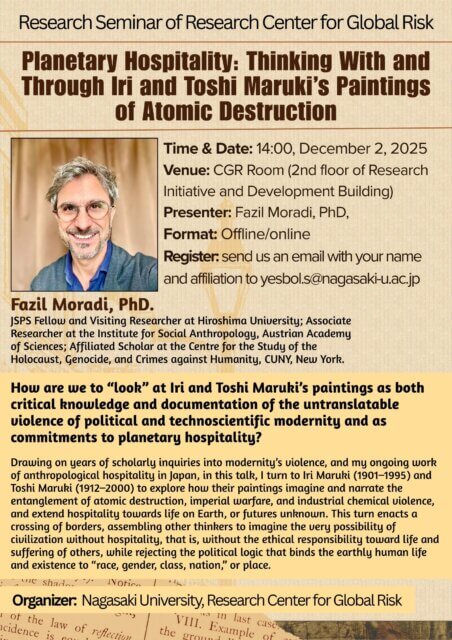


CGR Research Meeting
Theme: “Planetary Hospitality: Thinking With and Through Iri and Toshi Maruki’s Paintings of Atomic Destruction”
Date & Time: December 2nd (Tue), 14:00–15:30
Presenter: Dr.Fazil Moradi (Research Fellow, Hiroshima University)
Venue: CGR Office, Bunkyo Campus (2nd floor of Research Initiative and Development Building – Map ⑳ )
Format: Hybrid. Please inform us in advance whether online or in person. The Email address is below.
Language: English
Abstract:
How are we to “look” at Iri and Toshi Maruki’s paintings as both critical knowledge and documentation of the untranslatable violence of political and technoscientific modernity and as commitments to planetary hospitality?
Drawing on years of scholarly inquiries into modernity’s violence, and my ongoing work of anthropological hospitality in Japan, in this talk, I turn to Iri Maruki (1901–1995) and Toshi Maruki (1912–2000) to explore how their paintings imagine and narrate the entanglement of atomic destruction, imperial warfare, and industrial chemical violence, and extend hospitality towards life on Earth, or futures unknown. This turn enacts a crossing of borders, assembling other thinkers to imagine the very possibility of civilization without hospitality, that is, without the ethical responsibility toward life and suffering of others, while rejecting the political logic that binds the earthly human life and existence to “race, gender, class, nation,” or place.
Introduction:
Dr.Moradi explores modernity’s violence across Iraq, Rwanda, South Africa, Nigeria, Ghana, Western Europe and Japan. His recent works include Being Human: Political Modernity and Hospitality in Kurdistan-Iraq (Rutgers UP, 2024); “Can There Be Civilization Without Hospitality,” Journal of Genocide Research (2025); “Worldwide-ization of Epistemicide,” Journal of Genocide Research (2025); “In Search of Decolonised Political Futures: Engaging Mahmood Mamdani’s Neither Settler nor Native,” (Special Issue. Anthropological Theory 2023); “Spectres of Anton Wilhelm Amo” (Special Issue, Janus Unbound, 2025, co-edited by Stefanie Bognitz); “Catastrophic Art,” Public Culture (2022); Tele-Evidence: On the Translatability of Modernity’s Violence (Special Issue, co-edited by Richard Rottenburg, Critical Studies 2019; and Memory and Genocide: On What Remains and the Possibility of Representation (Routledge, 2017, co-edited by M Sixhohenbalken and R Buchenhorst).
Organizer: Nagasaki University, Research Center for Global Risk
Contact:yesbol.s*nagasaki-u.ac.jp(Please change * to @, when you send an email)